
 |


loading


| Product name: | |
|---|---|
| Feature: | |
| Type: | |
| Availability: | |
| Quantity: | |
XRT-GF
xinrui-te

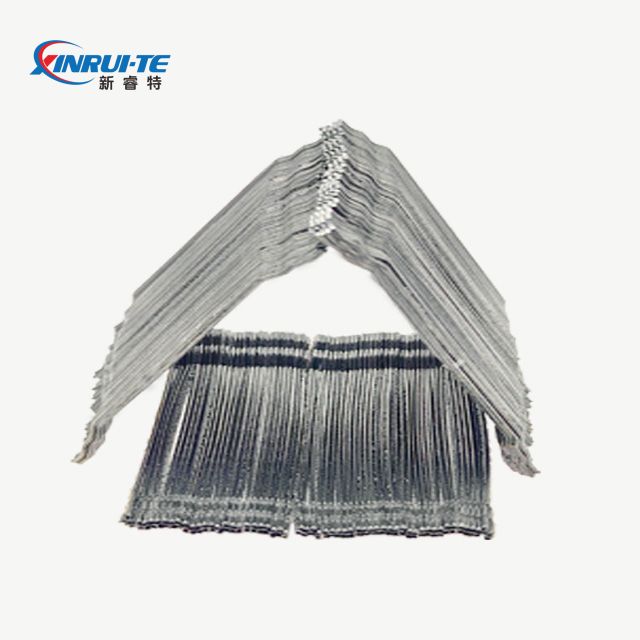
Glued Hooked End Steel Fiber is a high-performance concrete reinforcement material. Featuring excellent dispersion and strong mechanical anchorage, it effectively improves the crack and impact resistance, and overall durability of concrete structures, making it ideal for various heavy-duty construction projects.

◆ Dispersion Performance
Pre-glued bundles dissolve in water. Fibers disperse evenly without
clumping, ensuring stable strength.
◆ Bonding & Pull-out Resistance
Hooked design delivers strong anchorage. It has great crack resistance,
toughness and impact resistance, better than loose hooked fiber.
◆ Construction Efficiency
Easy to feed. No equipment blockage; shorter mixing time saves labor and energy.
◆ Workability
Uniform distribution keeps good workability, ideal for pumping, pouring and vibrating.
◆ Durability & Application
Good fatigue, shrinkage, and freeze-thaw resistance. It resists cracking and suits heavy-duty floors, tunnels, roads, and water
conservancy works.
◆ Cost Performance
Lower dosage cuts material cost. Less maintenance brings better economic benefits.

Industrial floor

Airport runway & apron

Building structure

Metro & Utility Tunnel

Road

Precast tunnel segment

Tunnel & underground

Dam

Wharf & Breakwater

Precast cover slab
| Project | Type | Dosage |
| Industrial floor /Heavy-duty warehouse | Glued or monofilament hooked end steel fiber | 20–40 kg/m3 |
| Bridge deck/Road paving | Glued or monofilament hooked end steel fiber | 30–60 kg/m3 |
| Tunnel /Shotcrere | Glued hooked end steel fiber or Copper-plated micro steel fiber | 30–50 kg/m³ |
| Mine, Metallurgy, Heavy abrasion | Mill-cut Steel Fiber | 60–90 kg/m³ |
| Ordinary civil floor & bedding | Straight Steel Fiber | 20–30 kg/m³ |
| Hydraulic dam, Wharf, Revetment | Glued Hooked End Steel Fiber | 50-80kg/m³ |
| coastal, chemical and saline-alkali areas | Copper-plated or anti-rust steel fiber is preferred. | 50-80kg/m³ |
1. Q: What projects are suitable for glued hooked end steel fiber?
A: It is perfect for industrial flooring, tunnel shotcrete, highway pavement, bridge works, airport runways, water conservancy and
port projects, as well as precast concrete components.
2. Q: Which steel fiber should I choose for pumped concrete?
A: Glued hooked end steel fiber is the best choice for pumped concrete. It keeps good fluidity and will not block pump pipes.
3. Q: How to add glued hooked steel fiber during concrete mixing?
A: Add sand, stone, and cement first, then put in steel fiber and admixtures, finally add water and mix fully. Do not untie the bundles
manually in advance.
4. Q: Will glued steel fiber affect concrete workability?
A: No. With uniform dispersion, it has little impact on concrete slump and workability, suitable for normal pouring and vibrating.
5. Q: What is the recommended dosage of glued hooked steel fiber?
A: 20-30 kg/m³ for industrial floors, 30-40 kg/m³ for tunnels, 25-35 kg/m³ for roads and bridges, 40-60 kg/m³ for hydraulic projects.

At a GlanceDispersion effect: Anionic carboxylic groups adsorb onto positively charged cement particles, creating electrostatic repulsion that breaks down flocculated cement structures and releases entrapped mixing water.Lubricating effect: Extended hydrophilic polyoxyethylene side chains form a den

Sodium Naphthalene Sulfonate (SNF) based admixtures are widely used as high-range water reducers in modern concrete production. By improving cement particle dispersion, SNF helps reduce water demand by around 18% to 28% while maintaining good workability and strength development. Its unique chemical

Global ocean freight keeps rising, with South America routes hit hardest. Traditional liquid PCE superplasticizer only has 40‑50% solid content. Water fills much of the container space, driving up logistics costs and increasing the risk of performance degradation during long‑distance hot sea transport. This article covers three main PCE forms: liquid, powder, and flake, and highlights the merits of flake or powder PCE superplasticizer. Cost simulation based on a 40'GP container shows that high‑solid solid‑form PCE greatly reduces freight cost per ton of active substance. With stable performance, long shelf life, low storage requirements, and good compatibility with ready‑mix concrete and dry mortar, it is a preferred cost‑saving solution for concrete admixture importers and distributors amid surging ocean freight.


Optimize concrete floors with PP hybrid macro synthetic fibers. Replace steel mesh, stop cracks, and boost durability with dual-action reinforcement.


