| Color: | |
|---|---|
| Solid content: | |
| Density: | |
| Cl-: | |
| Na2SO4: | |
| Availability: | |
| Quantity: | |
XRT-A
xinrui-te
382440
------XRT-A(Water reducing style)
XRT-A is a concentrated eco-friendly concrete admixture, a slump retaining polycarboxylate superplasticizer dominated by outstanding high water reducing performance. It features low alkali and environmental safety. A tiny adding amount can sharply reduce mixing water, save cement cost and improve concrete strength greatly.
Besides top water reduction, this polycarboxylate superplasticizer owns stable slump retention, little slump loss during transportation and construction. It matches precast, cast-in-place, high-strength, self-compacting and mass concrete, compatible with fly ash and slag powder. Without chloride, it prevents steel corrosion and concrete cracks.
Commonly used in high-speed rail, bridges, hydropower, nuclear power, subway, highway and harbor projects, it is ideal high water reducing polycarboxylate for ready-mix concrete factories and infrastructure contractors.
◆ The dosage of XRT-A is suggested as follows (wt.% of cement): 0.25%-0.8%.
◆ It can be mixed in metric water or added in concrete mixer. The
recommended stirring time is 150s at least. Concrete
mixing test should be made before using in order to insure concrete
quality.
◆ It can be compounded together retarder, defoamer, air-entertraning
reagent, lignin sulfonic natrium and so on.
| Feature | Description |
|---|---|
| High water reduction | The water reduction rate of concrete is above 30%-40%. |
| Easy control of production | XRT-A changeS the main chain molecular weight, side chain size, density and functional groups to adjust water reduction, concrete flow and air content, and keep concrete strength steady at the same time. |
| Good dispersion | It gives concrete great flow, so self-compacting concrete pours and settles easily on its own. |
| High strength gain rate | It boosts concrete’s early and final strength, cuts energy consumption from hydration, and lowers cracking, shrinkage and creep. |
| Wide adaptability | It works well with ordinary Portland cement, Portland cement, slag Portland cement and various mineral additives, with good dispersion and plasticizing effect. |
| Good strength and durability | Low void ratio, low alkali and chlorine-ion content. Enhance the strength and durability of concrete. |
| Environmentally friendly products | No pollution during production. |
| Low consumption and cost | It can be produced with a short cycle and low consumption, thus having a low cost. Especially suitable for commercial concrete. |
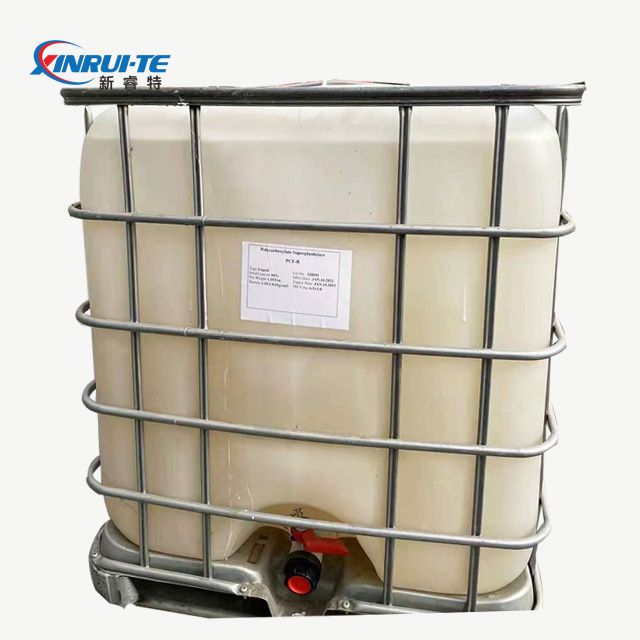
A. Liquid product: 230kg/200L PE drum,1150kg/IBC tank.
B. Sealed and stored under 0-35℃, far away from sunlight.
C. Shelf life is normally 12 months. It is tested for eligibility and then used when it exceeds.
As a professional polycarboxylate superplasticizer factory, we specialize in providing high-concentration PCE liquid tailored for global infrastructure demands. We offer polycarboxylate superplasticizer for sale in various packaging options, including 230kg drums and 1150kg IBC tanks, to meet different project scales. If you are looking for a trusted polycarboxylate superplasticizer manufacturer or seeking wholesale polycarboxylate superplasticizer at competitive factory prices, XRT-A is your ideal choice. Our chemical expertise ensures we are a leading supplier of PCE liquid, delivering consistent quality for precast and high-strength concrete applications worldwide.
1. Q:Does PCE affect concrete setting time?
A:Most PCEs have minimal or slight retarding effect. Specific molecular designs can accelerate or retard setting; field trials are
recommended.
2. Q:How compatible is PCE with different cement types?
A:PCEs are generally compatible with Portland, slag, and fly ash cements; clinker composition and SCM content affect performance
—conduct compatibility tests.
3. Q:What are the benefits of PCE for self-compacting concrete (SCC)?
A:PCE greatly enhances flowability and retention, reduces segregation, and improves fillability—making it ideal for SCC.
4. Q:Do chloride or sulfate ions in PCE affect concrete corrosion resistance?
A:Qualified PCEs are low-chloride and low-free-sulfate. High chloride can affect rebar corrosion—request chemical composition
and test certificates.
5. Q:What is the recommended addition sequence and mixing method?
A:Typically add PCE to the initial mixing water and mix thoroughly before adding other admixtures (per compatibility). Follow
supplier instructions for exact sequence.
6. Q:What water-reduction rate can PCE achieve?
A:Typical water reduction is 30–40%; high-performance formulations can exceed 40% under optimal conditions.
Learn how monofilament synthetic fibers provide 3D concrete reinforcement to prevent cracks, replace steel mesh, and enhance structural durability.
Optimize concrete floors with PP hybrid macro synthetic fibers. Replace steel mesh, stop cracks, and boost durability with dual-action reinforcement.
Learn to diagnose concrete mix imbalances. This guide covers water-cement ratios, admixture dosages, and testing to ensure structural durability.
Compare plasticizers vs. superplasticizers. Learn about water reduction, molecular mechanisms, and dosage to optimize concrete strength and budget.
Optimize industrial foam control with precise dosing, root cause analysis, and engineering strategies to prevent downtime and maximize process ROI.
Guide to steel fiber in concrete: Learn structural limits, ROI, and how to replace rebar in slabs and shotcrete for faster, more durable construction.
Learn how Polycarboxylate Superplasticizers (PCE) optimize concrete. Explore water reduction, UHPC/SCC applications, and expert selection strategies.
Master Polycarboxylate Superplasticizer (PCE) for high-strength concrete. Learn about its 50% water reduction, powder vs liquid, and applications.
Evaluate synthetic microfibers for construction and textiles. Balance structural performance with environmental compliance and sourcing risk mitigation.
Improve concrete workability and durability with sodium gluconate retarder. Learn about optimal dosage, chemical mechanisms, and project benefits.
Optimize concrete mix design with our guide to water-reducing agents. Evaluate PCE, SNF, and lignin to boost durability, strength, and workability.
Learn the difference between anti-foam agents and defoamers. Master preventive vs. reactive foam control to optimize industrial process efficiency.
Traditional concrete wall construction faces a long-standing set of operational challenges. Labor-intensive steel mesh installation consistently slows down project timelines. Over time, moisture penetration creates severe spalling risks as internal steel begins to corrode.
Traditional secondary reinforcement relies heavily on welded wire mesh. This approach demands significant manual labor. It frequently suffers from improper placement on job sites. Worse, it rarely prevents early-stage plastic shrinkage cracking.
Rising costs of heavily polymer-modified asphalt (PMA) and Stress Absorbing Membrane Interlayers (SAMI) are forcing pavement engineers to seek alternative mechanical reinforcement strategies.
Uncontrolled foam in industrial processes doesn't just look messy. It causes severe equipment cavitation and significantly reduces usable tank capacity. It also slows down production throughput and introduces critical defects into finished products.
Modern highway and industrial road construction faces massive pressure. Project owners demand aggressively accelerated timelines. They also expect extended lifecycle durability from every pavement slab.
Concrete contractors and specifying engineers face mounting operational challenges today. Unpredictable steel costs frequently squeeze tight project margins. Placing traditional welded wire mesh demands intensive manual labor and slows down pour schedules.
The concrete reinforcement industry is undergoing a massive shift. Engineers and contractors are rapidly moving away from labor-intensive traditional steel like rebar and wire mesh. Advanced engineered polymers now offer a smarter, highly efficient alternative for modern builds.
Managing foam generation remains a massive hurdle in food, beverage, and packaging production. Excess foam severely reduces processing throughput. It causes messy spillovers on facility floors. You must control this rapid macrofoam expansion without violating strict food-contact safety regulations.