| Availability: | |
|---|---|
| Quantity: | |
XRT-SWF
xinrui-te

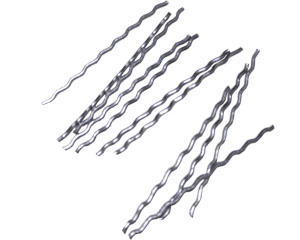
Waved steel fiber is a high-performance concrete reinforcement material. It effectively improves concrete impact resistance, fatigue resistance, and impermeability. Featuring high tensile strength, excellent toughness, and strong cost-effectiveness, it is an ideal replacement for steel mesh fiber. Compared with other types of steel fiber, our wavy steel fiber is widely used in infrastructure projects, including slopes, bridges, tunnels, airport runways, ports and railway sleepers.
Waved Steel Fibers Technical Advantages
| Technical Advantage | Detailed Explanation |
|---|---|
A. Enhanced Bonding Performance | - Strengthens adhesion between steel fibers and concrete matrix - Enables use of higher-strength concrete formulations |
| B. Increased Aspect Ratio (lf/df) | - Optimizes fiber length-to-diameter ratio to enhance mechanical interlock - Improves load transfer efficiency between fibers and matrix |
| C. Wave Structure Design | - Corrugated shape increases frictional resistance and bite force between fibers and matrix - Enhances the steel fiber influence coefficient (mechanical anchoring effect) |
1. Waved Steel Fiber
It delivers the best overall performance with excellent impact resistance, fatigue
resistance and impermeability.
Application: Large-scale infrastructure projects including bridges, tunnels, airports,
ports, railway sleepers and slope protection.
2. Shear Steel Fiber
Features strong bonding force, outstanding wear resistance, and impact resistance.
Application: Industrial floors, heavy-duty pavements, mining projects and port yards.
3. Hooked End Steel Fiber
Offers reliable anchoring performance, great crack resistance, and bending resistance.
Application: Building floors, roof slabs, precast concrete components, and water conservancy projects.
4. Straight Steel Fiber
Low cost and easy to mix with concrete.
Application: Common floors, simple slope protection, secondary anti-seepage structures, and low-load projects.
5. Copper-coated Micro Steel Fiber
Fine diameter, good dispersion, and superior rust resistance, ideal for high-strength concrete.
Application: RPC / UHPC ultra-high performance concrete, precast parts, decorative components and projects under highly corrosive
environments.
1. Q: How to choose fiber length and diameter?
A: Choose by element thickness, pumpability, and mechanical needs—short (30–60 mm) for spraying/thin slabs; longer for higher
tensile/flexural demands.
2. Q: What concrete performances can be improved by adding corrugated steel fiber?
A: It can greatly improve concrete performance in impact resistance, fatigue resistance, crack resistance, impermeability, and wear
resistance, and extend the service life of concrete structures.
3. Q: How does it perform with admixtures?
A: Compatible with typical plasticizers and superplasticizers; superplasticizers improve workability. Conduct trial mixes to confirm.
4. Q: How to choose among wavy steel fiber, shear steel fiber and hooked end steel fiber?
A: Choose wavy steel fiber for bridges, tunnels, airports, and railway sleepers; shear steel fiber for heavy-duty floors and mining
projects; hooked-end steel fiber for building floors and precast components.
5. Q: Can it replace rebar or wire mesh?
A: It can partially/fully replace mesh in many non-primary-load elements; main structural reinforcement must follow design codes.
6. Q: What are the main technical specs?
A: Key specs: length, diameter, tensile strength, surface profile (waved), single-fiber weight, and coating (e.g., galvanized). These
determine performance and dosage.
7. Q: Can your factory provide customized corrugated steel fiber in different specifications?
A: We provide customized products in different lengths, wire diameter, and tensile strength according to clients’ drawings and
project requirements.
Polypropylene Fiber for Concrete is a high-performance synthetic additive uniformly dispersed throughout the concrete matrix to prevent plastic shrinkage cracking, enhance impact and abrasion resistance, reduce permeability, and improve structural durability across both fresh and hardened states.Wha
This article analyzes the steady rise in **PCE superplasticizer** prices in 2026, driven mainly by crude‑oil volatility and geopolitical tensions in the Middle East. Based on the naphtha‑cracking route, it quantifies how oil‑price changes transmit through EO and TPEG to affect the costs of PCE powder and 40% liquid mother liquor. Three oil‑price scenarios illustrate potential cost fluctuations. It also shares practical coping strategies for overseas buyers, covering contract optimization, inventory‑logistics adjustment, product‑form selection, downstream cost transfer, and raw‑material price monitoring, to help importers mitigate market risks amid price turbulence.
ConclusionControlling bleeding in concrete made with polycarboxylate superplasticizer is a comprehensive process involving several factors. These include:※ Customized design of the polycarboxylate water reducers’s molecular structure※ Proper use of air-entraining agents and viscosity-modifying admix
At a GlanceDispersion effect: Anionic carboxylic groups adsorb onto positively charged cement particles, creating electrostatic repulsion that breaks down flocculated cement structures and releases entrapped mixing water.Lubricating effect: Extended hydrophilic polyoxyethylene side chains form a den
Sodium Naphthalene Sulfonate (SNF) based admixtures are widely used as high-range water reducers in modern concrete production. By improving cement particle dispersion, SNF helps reduce water demand by around 18% to 28% while maintaining good workability and strength development. Its unique chemical
Global ocean freight keeps rising, with South America routes hit hardest. Traditional liquid PCE superplasticizer only has 40‑50% solid content. Water fills much of the container space, driving up logistics costs and increasing the risk of performance degradation during long‑distance hot sea transport. This article covers three main PCE forms: liquid, powder, and flake, and highlights the merits of flake or powder PCE superplasticizer. Cost simulation based on a 40'GP container shows that high‑solid solid‑form PCE greatly reduces freight cost per ton of active substance. With stable performance, long shelf life, low storage requirements, and good compatibility with ready‑mix concrete and dry mortar, it is a preferred cost‑saving solution for concrete admixture importers and distributors amid surging ocean freight.
Optimize concrete floors with PP hybrid macro synthetic fibers. Replace steel mesh, stop cracks, and boost durability with dual-action reinforcement.